Japanese Garden Design Adelaide — Plants, Stones, Cost
Designing a Japanese garden in Adelaide — best plants, hardscape elements, scale considerations, and how to adapt the style to local climate.
Published 9 May 2026 · Landscaping Quotes
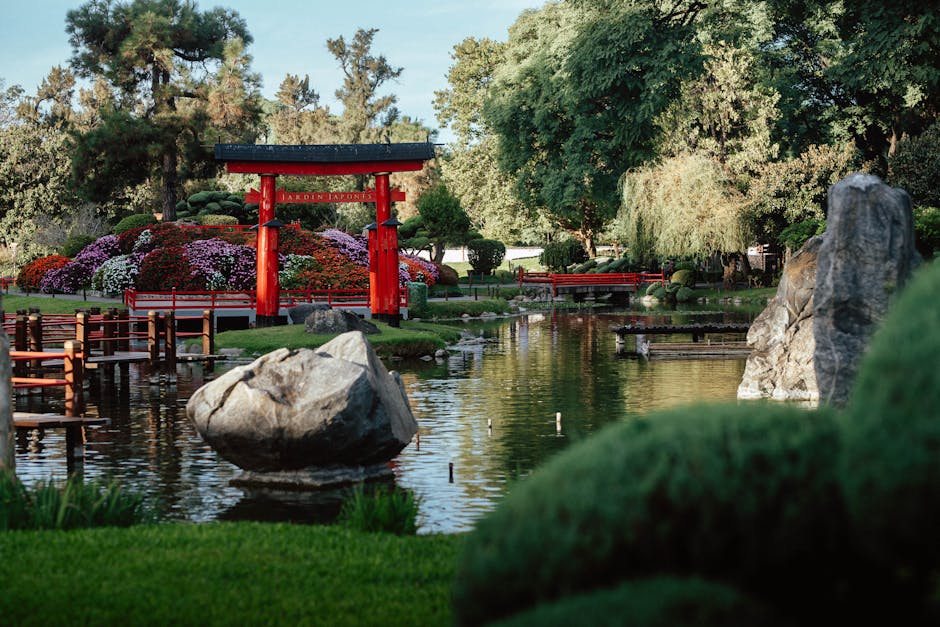
Japanese Garden Design in Adelaide — Plants, Stones, and Process
Japanese-inspired gardens work surprisingly well in Adelaide. The dry summers favour drought-tolerant Japanese-style plant palettes, and our cooler springs and autumns echo the seasonal aesthetics central to traditional Japanese garden design.
The trick is adapting the principles, not literally copying the materials.
Core principles
Traditional Japanese garden design rests on five core ideas, all of which transfer to Adelaide:
1. Asymmetry and balance
Avoid mirror-symmetry. Place stones, plants, and structural elements in odd numbers (3, 5, 7) and at varying distances. The garden should feel composed, not arranged.
2. Borrowed scenery (shakkei)
Frame views into the distance — a tree on a neighbour’s property, the hills, a glimpse of sky. The garden visually extends beyond its boundaries.
3. Concealment and reveal
Paths curve so the garden reveals itself slowly. A view through a moon-gate or between two trees becomes a moment.
4. Empty space (ma)
Restraint is the discipline. Leave gravel or moss-covered ground untouched. The empty space is as important as what fills it.
5. Suggesting nature in miniature
Stones become mountains. Gravel raked into patterns becomes rivers. A pruned pine becomes a forest in one tree. Scale is suggestive, not literal.
What works for Adelaide
Plants
- Japanese maple (Acer palmatum) — works in protected courtyards and the Adelaide Hills. Struggles in full afternoon sun on the plains.
- Pine (Pinus mugo, Pinus parviflora) — drought-tolerant, takes pruning well.
- Bamboo (Phyllostachys species in containers, never in-ground) — reads as Japanese instantly. Containerise to control spread.
- Camellia (sasanqua varieties) — classic Japanese flower, prefers slightly acidic soil; amend with sulphur on alkaline plains.
- Mondo grass (Ophiopogon) — black or green, reads as moss-substitute in Adelaide’s drier climate.
- Iris (Iris ensata, Iris siberica) — Japanese iris, prefers consistent moisture.
- Dwarf nandina — Japanese sacred bamboo, drought-tolerant once established.
- Azalea (kurume) — works in shade-protected sites; alkaline-soil varieties needed for plains.
Avoid traditional moss (Adelaide’s too dry). Substitute mondo grass, dichondra, or fine native ground covers.
Hardscape
- Crushed granite or fine gravel for raked surfaces. Decomposed granite is the volume product.
- Larger stones as feature elements — basalt, slate, or local sandstone all work.
- Bridges and stepping stones — concrete or bluestone slabs.
- Stone lanterns (real or cast). Available through specialist suppliers.
- Bamboo screens — for boundary screening, not load-bearing.
Water features
A koi pond is the traditional centrepiece but high-maintenance in Adelaide:
- Evaporation is high (top up weekly through summer)
- Fish stock vulnerable to herons and warm-water disease
- Algae management is constant
Alternatives: a rill (narrow water channel), a tsukubai (stone basin with bamboo spout), or a dry stream-bed (gravel arranged to suggest water flow).
Scale considerations
A traditional Japanese garden assumes substantial space — typically 200sqm+. For Adelaide townhouses and courtyards (50-100sqm), adapt by:
- One or two feature plants instead of layered planting
- A simple gravel area with three feature stones (avoid the temptation to fill it)
- A single water element (small basin, not a pond)
- Restraint on hardscape diversity — one stone type, one path material
Maintenance
Japanese-style gardens are not low-maintenance — they’re calm-looking but heavily groomed:
- Weekly: rake gravel patterns, clear leaf debris, inspect feature plants
- Monthly: prune feature plants to shape (Japanese maples, mondo grass, mugo pines)
- Annually: refresh gravel, replace moss substitutes, structural prune of pine
The discipline is part of the aesthetic. If you want low-maintenance, this style isn’t it.
Cost in Adelaide
For a 60sqm Japanese-influenced garden:
- Concept design: $2,500–$5,000 (specialist designers cost more)
- Hardscape (paths, decomposed granite, feature stones, water element): $12,000–$25,000
- Planting (specimen Japanese maple + mid-storey + ground cover): $4,000–$10,000
- Total: $18,500–$40,000
Specimen Japanese maples (3+ years old) start at $400 and run to $2,000+ for advanced trees.
Common mistakes
- Too much. Western design instinct fills space. Japanese restraint requires emptying it.
- Wrong scale. Stones too small for the space, or trees too crowded.
- Imported moss. Won’t survive Adelaide summers. Use mondo or dichondra.
- Bonsai-pruned everything. Restraint applies to pruning too — only feature plants get the cloud-prune treatment.
Get a free Japanese garden quote
Request a free design quote and mention “Japanese-influenced” in the brief. Few Adelaide designers specialise but several can adapt principles competently.
Get a free landscaping quote
Tell us about your project and we'll get back to you within 24–48 hours. No obligation.